


CERN Bets on the Future: FCC-ee Could Become the Successor to the Large Hadron Collider
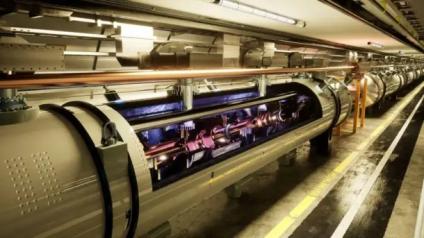
Artistic impression of the FCC-ee (Image: CERN)
On 22 May 2026, CERN made a strategic decision that will shape the future of global high-energy physics for decades to come. The CERN Council updated the European Strategy for Particle Physics and recommended the Future Circular Collider electron-positron collider (FCC-ee) as the priority project - a potential successor to the Large Hadron Collider (LHC).
The FCC-ee is considered one of the most ambitious scientific projects of the 21st century. It is designed to become a new generation of particle accelerators capable of delivering unprecedented precision in studying the fundamental structure of matter and the Universe.
Focus on the Higgs boson and “new physics”
Since the discovery of the Higgs boson at the LHC in 2012, this particle has remained one of the key elements in understanding the nature of the Universe. The future FCC-ee collider is envisioned as a “Higgs factory,” enabling extremely precise measurements of its properties while also searching for phenomena beyond the Standard Model of particle physics.
CERN emphasizes that the FCC-ee will open broad opportunities for groundbreaking discoveries — from the study of dark matter to investigating why matter dominates over antimatter in the Universe.
At the same time, the current Large Hadron Collider will continue operations. A key priority for the coming years remains the completion of the High-Luminosity LHC (HL-LHC) upgrade programme. The facility is expected to operate at least until 2041.
Decision in 2028, launch in the 2040s
The final decision on the construction of the FCC-ee is expected to be made by CERN Member States and international partners around 2028. If approved, the new collider could begin operations in the mid-to-late 2040s, following the end of the LHC era.
CERN Council President Costas Fountas emphasized that the scientific community has effectively reached a consensus: the FCC-ee is expected to secure CERN’s leadership in accelerator physics for the coming decades.
Ukraine among the participants in the future project
This strategy is also of special importance for Ukrainian science. On 10 January 2025, CERN and Ukrainian scientific institutions and higher education establishments signed an online Memorandum of Understanding regarding the feasibility study of the future FCC collider. The document confirmed the readiness of Ukrainian scientists to contribute to future high-energy physics experiments and participate in shaping new global scientific infrastructure.
Among the Ukrainian institutions that joined the Memorandum is the Institute for Scintillation Materials of the NAS of Ukraine.
The participation of Ukrainian researchers in such large-scale international projects is not only recognition of the high level of Ukrainian science, but also an opportunity to help shape the future of fundamental physics.
Full article available in the heise online information bulletin: https://www.heise.de/news...
The FCC-ee is considered one of the most ambitious scientific projects of the 21st century. It is designed to become a new generation of particle accelerators capable of delivering unprecedented precision in studying the fundamental structure of matter and the Universe.
Focus on the Higgs boson and “new physics”
Since the discovery of the Higgs boson at the LHC in 2012, this particle has remained one of the key elements in understanding the nature of the Universe. The future FCC-ee collider is envisioned as a “Higgs factory,” enabling extremely precise measurements of its properties while also searching for phenomena beyond the Standard Model of particle physics.
CERN emphasizes that the FCC-ee will open broad opportunities for groundbreaking discoveries — from the study of dark matter to investigating why matter dominates over antimatter in the Universe.
At the same time, the current Large Hadron Collider will continue operations. A key priority for the coming years remains the completion of the High-Luminosity LHC (HL-LHC) upgrade programme. The facility is expected to operate at least until 2041.
Decision in 2028, launch in the 2040s
The final decision on the construction of the FCC-ee is expected to be made by CERN Member States and international partners around 2028. If approved, the new collider could begin operations in the mid-to-late 2040s, following the end of the LHC era.
CERN Council President Costas Fountas emphasized that the scientific community has effectively reached a consensus: the FCC-ee is expected to secure CERN’s leadership in accelerator physics for the coming decades.
Ukraine among the participants in the future project
This strategy is also of special importance for Ukrainian science. On 10 January 2025, CERN and Ukrainian scientific institutions and higher education establishments signed an online Memorandum of Understanding regarding the feasibility study of the future FCC collider. The document confirmed the readiness of Ukrainian scientists to contribute to future high-energy physics experiments and participate in shaping new global scientific infrastructure.
Among the Ukrainian institutions that joined the Memorandum is the Institute for Scintillation Materials of the NAS of Ukraine.
The participation of Ukrainian researchers in such large-scale international projects is not only recognition of the high level of Ukrainian science, but also an opportunity to help shape the future of fundamental physics.
Full article available in the heise online information bulletin: https://www.heise.de/news...